A Different Kind of State-Church Separation

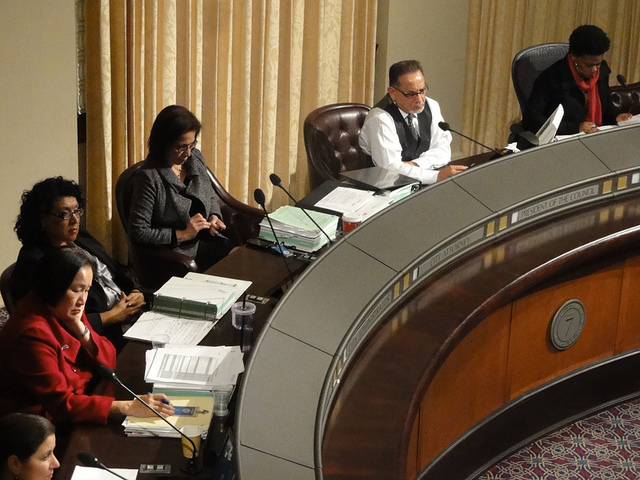
2011-12-20 Oakland City Council Meeting

I’m interrupting the heartwarming choir tour stories to get to one of the reasons I started this blog:  to talk about how important it is to wrestle with the hard questions, because quick and simple answers can be wrong.  I want to address a story in the news before it gets cold.

A Collin County commissioner introduced a resolution saying that Collin County should not use any of its resources to deal with all the children coming over the border.  The Commissioners Court passed The Proper Role of County Government in Providing Temporary Housing and Care for Migrant Children, which says it is not the function of county government to provide aid beyond what are considered core functions of county government:  law enforcement, health care services, and child protective services.  They applaud the work churches and charities do in caring for these children.  Please take some time to click on the link and read the resolution.  (I had a little trouble with the link; hit the refresh button if the document doesn’t appear.)  Part of the point of wrestling with hard questions is working from primary sources.

There are many important points on both sides of this situation.  The children are in this country in violation of US immigration law.  On the other hand, these children are fleeing political unrest and lawlessness in their home countries.  Our immigration system couldn’t handle all the people who would enter the country if we dropped all immigration restrictions.  On the other hand, we have an obligation to protect defenseless children.  We have an obligation to uphold the rule of law.  On the other hand, we could be sending these children back to their deaths.  As citizens, we’re obligated to wrestle with the questions this situation raises.

The commissioners start each meeting with a prayer.  Most Commissioners Courts do.  There is usually a lot of outrage when they don’t.  The argument usually runs that the country was founded on Christian principles and blocking a public prayer is contrary to our founders’ intentions.  They should do the Christian thing and open their meetings with prayer.  But those who opposed this resolution think accepting and sheltering these children is also the Christian thing to do.  The Commissioners Court acknowledged it is a Christian duty, but the county is also responsible to state and federal law.  However, we also remember Judge Roy Moore, who erected a monument of the Ten Commandments as an act of civil disobedience.

What makes a country (or a county) “Christian”?  Is it measured by works of piety or works of mercy?  This is not about separation of church and state in the First Amendment sense, but it is about drawing some kind of boundary between the two.  Where does county stop and church start?  When we open a meeting by asking God to guide us, are we prepared for what God might do?

I would love to hear your thoughts.  This is controversial, so please remember your manners.  I will delete hateful or profane comments.

I promise my next post will be a heartwarming story.

Image is “2011/12/20 Oakland City Council Meeting” by Daniel Arauz on Flickr, CC BY-NC-SA 2.0.  This is not the Collin County Commissioners Court

Thoughts on LPYC Choir Tour – Day Four – Best Choir Experience Ever (The Roots of Theology, Part 2)

This is one of a set of blog entries inspired by the 2014 tour of the Living Proof Youth Choir (LPYC) of Christ UMC in Plano, Texas.  It isn’t meant to be a summary of the tour, but a set of reflections prompted by events on the trip.

north-austin-20

I thought we were in the wrong place.

I asked Connor, my navigator, where we were supposed to be.  He said New Kingdom Church.  That’s what the sign said.  I was driving the van, we got separated from the bus, and Connor used his phone to get us here.  We had obviously beaten the bus.  Two men were grilling and I knew the church was going to feed us, so this looked like the place.  It’s not like all our other engage­ments had been in cathedrals, but this place was small.  It was surrounded by a steel fence with an auto­matic gate, probably to prevent vandalism.  This was not our usual venue, not our usual neighbor­hood.  But it looked like the right place, so I got out to say hello.

I met Derrell, the youth pastor, and he looked confused, too.  I said we were from the choir that was singing tonight, which got rid of some confusion.  When I told him we had a bus with the rest of the choir, it got rid of the rest.  The bus pulled up and as choir got off the bus in their blacks and whites, the ties and dresses, I saw Derrell brighten up.  Trey and Jim, the director and accompanist, began talking to the men and I went inside to change into my dress up clothes.

We were at the right place.  New Kingdom Church is a nondenominational, African-American church on the in Chicago’s Austin neighborhood.  It isn’t far from where we sang that morning, the By The Hand Club for Kids.  That organization “helps children who live in high-risk inner-city neighborhoods have abundant lives.”  Those children, elementary school aged, loved having the “big kids” come play with them.  I saw some chil­dren of that age at New Kingdom and wondered if some of them either went to By The Hand or knew someone who did.

Elvis Costello said, “Writing about music is like dancing about architecture.”  It’s hard to convey what hap­pened that night.  Everyone knows African-American worship carries an enthusiasm that Anglo worship doesn’t.  The effect on the choir was dramatic.  The first songs went well, but as time went by the choir and the congregation connected.  Shouts from the congregation became part of the song.  Lines from the songs demanded and received responses from the congregation.

The choir sang a while, then New Kingdom showed us their best.  We saw their dance team, heard a young lady sing who was headed to college on a music scholarship, and heard from another on how much God had done in her life through New Kingdom’s ministry.  Then the choir sang more.

There are a lot of songs I could write about, but I want to lift up two.

The song Order My Steps is a prayer, but on that night it was preaching.  The congregation added its voice to each request:  to order our steps and our tongues in Your Word, to guide our feet and wash our hearts in Your Word, to be shown how to walk and talk in Your Word.  Each line built on the next, with the choir stepping up to match the intensity of the congregation.  All the dynamics, all the phrasing, all those things choir directors have to pull out of their choirs, came naturally out of the choir as the congregation and the director shaped the music.

Trey moved the high energy Praise His Holy Name to the end of the program.  I’ve seen videos of other choirs doing this song, with their directors desperately trying to get them to loosen up.  That wasn’t our problem.  The choir was ready; the congregation was willing.  “Praise His Holy Name” was a com­mand to the congre­gation – and they followed.  I wrote about this already, but it became clear the song was going to end too soon, so Trey drew it out.  It was guys only, girls only, with and without piano, always with shouts every time the music changed.  Trey brought it to an end and the room exploded.

I can’t call this a performance or a concert.  Everybody did something to make it happen; everything came together.  We were in the right place.

New Kingdom’s kids took the choir downstairs to eat.  It was a replay of that morning, with the younger kids thrilled to have the attention of the older kids.  We later learned a man came in from the street, wondering what all the singing was about, and stayed to hear the rest of the music.  A lady from New Kingdom told us she was going to set up the food and leave, but decided to stay when she heard the singing.  I heard my favorite line of the week:  “When I closed my eyes, I forgot you were a white choir.”

This is another root of theology.  How is it that people that are so different are so alike?  What brings us to­gether?  How did this music become our common ground?  To find out, you have to leave the comfort zone of where you are, live in someone else’s world, and let them share with you.  When you close your eyes, you forget the differences.  You under-stand you’re in the right place.

Both my parents came from large families.  I remember family gatherings and summer nights in Arkansas, running around in someone’s front yard with my sister and cousins.  The adults would tell us it was time to go and eventually herded us into our cars, but I don’t think they wanted to leave any more than we did.  It was getting time to leave New Kingdom, so I left the building and stepped into a front yard in Arkansas.  Kids from the Austin neighborhood were running around with upper middle class suburban kids, in between groups of chap­er­ones and church members.  After talking for a while, and a while more, we herded ourselves onto the bus and the van.  I don’t think anyone wanted to leave, but tomorrow was going to be an early day.  We had to break up the family gathering.

When this evening started, we weren’t sure what to expect from each other, but when you close your eyes, there’s some things you forget – and some things you learn.  The opinion on the van was unanimous:  Best Choir Experience Ever.

That happens when you’re in the right place.

Thoughts on LPYC Choir Tour – Day Four – The Roots of Theology, Part 1

This is one of a set of blog entries inspired by the 2014 tour of the Living Proof Youth Choir (LPYC) of Christ UMC in Plano, Texas.  It isn’t meant to be a summary of the tour, but a set of reflections prompted by events on the trip.

I’m still learning WordPress.  The entry I posted on LPYC Day Three was actually an earlier draft.  I made one small but significant change near the end.  I said, “While in Chicago, what we sought, we found.  What we summoned, found us.  We beckoned lovely and made the most of our time here.”  Here’s the change:  In Chicago we found what we didn’t know to seek and learned that God finds us better things than we know to summon.  With a buildup like that, I need to get on with it . . .

track and field image

Day Four (Tuesday) started with me driving the van to our first stop.  We travelled in a bus and a van, and it was my group’s turn to ride in the van.  Becca was riding shotgun and reading that day’s devotional.  She said, “We’ll have a lot of discussion on this one tonight.”  We discuss the devotional each evening as an entire choir, right before lights out.

Natalie wrote this one, the same Natalie who sings Christ has Broken Down the Wall.  Here’s the devotional, reprinted with her permission.  (Thanks, Natalie!)  Something to know before you read:  running track is an important part of Natalie’s life and she will be attending college on a track scholarship.

“Now faith is confidence in what we hope for and assurance about what we do not see.” – Hebrews 11:1

When I think of faith, the first thing that comes to my mind is the phrase, “Don’t stress, God has a plan.  Trust that God will pull you through this plan and you’ll become stronger because of it.”  We have all heard this familiar saying so many times throughout our lives, and it’s comforting to hear that bad situations will be in God’s hands.  But let me ask you, does it really comfort you to hear that it was God’s plan all along to put a bad situation or circumstance in your life?  Personally, I very much dislike the phrase “God has a plan” because I don’t believe that my God would kill the innocent, disease the good, split up parents, and more.  God didn’t just plan to cripple me for almost a month with severe arthritis, which I still have. . .  He just doesn’t do that!  It’s absurd to think that part of His plan is to make your life harder than it needs to be.  Yes, I will say that it is likely that you will be inspired, learn something, or become physically and mentally stronger because of a bad situation.  Your faith in the Lord might even become stronger, but His intention isn’t to strengthen your relationship with Him by giving you a tough time.  He will always love you and give you the opportunities that you need in your life no matter what.

 Now let’s go back to about the seventh or eighth grade and talk about the poem that we have all read by Robert Frost called “The Road Not Taken.”  In this poem, Frost is presented with two paths.  Just by skimming through it, you would conclude that he chose a path that was less traveled, making you think that he chose the one path that would make his life easier.  He makes you think that he knew which path was better for his life!  However, if you further analyze the piece, you figure out that both paths are equally worn, and Frost really had to choose his path by complete chance, not knowing which path would be easier, and not knowing what struggles would lay ahead.

What I take from this poem is that we are free to choose, but we will never know what we are actually choosing.  Our life “path” is determined by choice and chance, God has nothing to do with it, because He gave us our free will.  Bad things happening in our lives are just a part of life.  We should always try to use those bad situations to our advantage by finding a way to become stronger, and use God to our advantage by strengthening our faith with Him, because He is the one who you will find comfort in, and never the one you should take out your anger on.  He didn’t plan your struggles; it was chance.  Take the time to thank Him for the fact that you have free will in your life, and can trust in Him even when you do not know what lies ahead.

I am assembling a list of phrases I want to truly understand before I graduate seminary.  “God has a plan for your life” is near the top.  Are those terrible things part of God’s plan?  As Becca read, I thought about my mother.  I thought about how important her family was to her and how much she loved being a grandmother.  Yet in three years’ time, I became someone she thought she knew, but wasn’t sure.  She would go from being uncertain about having grandchildren to not knowing if she had any.  In finding care for her, I met a lot of people like her.  If God had a plan, why did it lead here?

Natalie’s work crosses over from devotional into theology.  The discussion that evening included “How can you question God?”  In our discussion, we recapitulated the Book of Job.  Job insisted on questioning God; his three friends insisted he shouldn’t.  But it’s the Book of Job, not the Book of Eliphaz, Bildad, and Zophar.  God says to them, “You have not spoken of me what is right, as my servant Job has.” (Job 42:7)

Theology starts when someone pulls us from the comfort zone of pre-packaged Sunday School answers, challenging us to look harder and think better.  That’s one of the roots of theology.  There is another, involving another comfort zone, which happened that evening.  Stay tuned.

Image is 09 State Track 0314 by el_gallo on Flickr, CC BY-NC-ND 2.0.  Natalie is not in the photo.

Encore: Thoughts on LPYC Choir Tour – Day Two – Owning the Music

As I’m working on (yet again) restarting this blog, I thought I’d bring back a series I wrote in 2014 about a youth choir tour, originally published in July 2014.  Enjoy.


This is one of a set of blog entries inspired by the 2014 tour of the Living Proof Youth Choir (LPYC) of Christ UMC in Plano, Texas.  It isn’t meant to be a summary of the tour, but a set of reflections prompted by events on the trip.

Tour Day Two was a Sunday.  The choir sang for the two worship services at First & Calvary Presbyterian Church in Springfield, Missouri.  Their program is a worship service, with hymns, responsive, readings, and corporate prayers in between the songs.  The pastor introduced us, then turned the worship hour over to LPYC.

I attended most of the rehearsals the week before the tour.  Rehearsals recall the old saying that if you like sausage, you shouldn’t watch anyone make it.  Trey, the director, spent his share of time telling the youth to stop talking and put away their phones.  It takes effort to pull a group of high schoolers’ voices into a choir.  Going into the tour, I felt that they knew the music well, but as I was listening to them that Sunday morning, I heard a level of mastery I didn’t hear in the rehearsals.  There’s knowing the music and there’s owning the music.

At the second service, the choir added hand motions to Praise His Holy Name.  It started in the guys’ section and rippled over to the girls’ section.  They loved the song, felt comfortable playing with it, and so they had a little fun.  This was, of course, as much a surprise to their director as it was to everyone else.  But when you own the music, you can make things happen.

Two days later, LPYC sang at New Kingdom Church, an African-American church on Chicago’s West Side.  When they sang Praise His Holy Name, the energy level in the room, high to begin with, doubled or tripled.  When you own the music, you can make things happen.  Instead of ending the song, Trey kept it going.  It was guys only, then girls only, with the piano, without the piano, then going down to a whisper and back up to a shout.  The choir agreed it was their best tour experience ever.

When you own the music, you can make things happen.  When you own the music, the message follows.

A few years ago I sent a survey to our clergy asking how long it took to prepare a sermon, where their ideas came from, who their preaching heroes were, etc.  I was especially interested in how long it took to pull a sermon together.  I thought the more experienced preachers would take less time, and when it comes to pulling the text of a sermon together, that’s true.  But the process of sermon preparation changes with experience.  All pastors read the scriptural text two to three weeks before that Sunday and then mull over the passage, looking for the message they need to bring out.  Experienced preachers know how to dwell in the scripture over that time.  It becomes a part of them.  They learn how to be open to the insights God brings over that time.  They learn how to own the scripture and it shows in their preaching.  They’ve found their voice and are confident in it.

I’ll talk about Glenn Burleigh’s Order My Steps in a later post, but let me say now I woke up each morning with “Order my steps in your Word” running through my head.  In my morning devotional time, I pondered what it meant to “walk worthy, my calling to fulfill”.  When you own the music, the message follows.  It’s a part of you like nothing else is.  That’s why we sing so much of our theology.

I’ve looked on iTunes for recordings of Keith Hampton’s Praise His Holy Name, Mark Miller’s I Believe, and Glenn Burleigh’s Order My Steps that are as good as what I hear from LPYC.  I haven’t found them.  I am, of course, completely biased, but I can’t imagine these songs coming from anyone else.  That’s the other part of owning the music and the message, you’re part of a bond.  I’ll have more on that later.

Great things happen when you own the music.  Greater things happen when you own the message.

Thoughts on LPYC Tour 2014 – Day One

This is the start of a set of entries inspired by the 2014 tour of the Living Proof Youth Choir (LPYC) of Christ UMC in Plano, Texas. It isn’t meant to be a summary of the tour, but a set of reflections prompted by events on the trip.

The first stop on the tour is Springhill, an assisted living facility in Neosho, Missouri.  This tour will take us to St. Louis and Chicago and back.  We will sing for churches, for a children’s ministry, for a homeless ministry, and for places like Springhill.

The choir program includes Christ has Broken Down the Wall by Mark Miller. It works the way most powerful songs work, with a simple melody and simple words. It starts with a solo voice:

Christ has broken down the wall. Christ has broken down the wall. Let us join our hearts as one. Christ has broken down the wall.

The soloist this year is Natalie, who sings as if the song was written for her. I can’t listen to this song without feeling the tears, and they start when Natalie starts. By the end of the tour, Natalie will sing through her own tears.

We’re accepted as we are. We’re accepted as we are. Through God’s love all is reconciled. We’re accepted as we are.

Lately I’ve spent a lot of time in assisted living facilities. It’s a place where your limitations seek to define you. As my mother’s dementia worsened, her needs became greater than our ability to respond. My sister and I placed her in a facility that cares for Alzheimer’s and dementia patients, where she lived until her death last April. The same week as her death, my father suffered a severe stroke. He’s recovering well, but he now has to learn to live with a set of physical limitations. He’s living in a facility that can assist him with those tasks he can no longer do safely. I associate these places with limitations, with finitude.

The people here live with finitude. The rest of us know in our heads that we’re finite, but we’re able to go for long stretches without thinking about it. In this setting, I listen to a song that tells me how we’re all accepted, limitations and all.

Cast aside your doubts and fears. Cast aside your doubts and fears. Peace and love freely offered here. Cast aside your doubts and fears.

The idea for this entry came from this verse. It seems that life saves some of its biggest challenges until you’re frailest. Your limitations remind you of what you can’t do. You’ve lost friends and loved ones. It takes a lot of courage to grow old. You get to see those who embrace life even at this stage.

We will tear down the wall. We will tear down every wall. God has called us one and all. Christ has broken down the wall.

They sing this verse with such conviction that I believe they will be the ones to do it. The words change from “we will tear down the wall” to “we will tear down every wall”. The singers may be young, but they understand finitude. There are those with chronic health problems, those who have family members with chronic health problems, and those whose parents have divorced. There are those who bring themselves to church; whose families don’t share in the faith they have found. Being a teenager means wanting greater independence, but not being able to claim it just yet. These singers know about walls.

After the choir sings, the students visit with the residents.  They get along so well, everyone smiling and laughing.  The residents share their stories and the students are eager to listen.  There’s a joke that says grandparents and grandchildren get along so well because they have a common enemy. These high school students and these elderly residents have finitude in common. It’s another reminder of how important it is to have each other, how much we really need each other, how important it is for us to connect with each other.

After all, it’s “WE will tear down the walls.”

This link goes to a video of the song being performed on a previous choir tour. You will see that year’s choir performing at churches, visiting the residents of a nursing home and a homeless ministry, and having some fun.