Transitions

and so my journey began

As I’m in the process of leaving a volunteer ministry position at one church to accept a paid staff position at another, I’ve been thinking about hometowns.

I’m an Air Force brat.  I grew up moving around.  It’s a great way to grow up; I lived across the country from South Carolina to Arizona and even in Japan.  You meet all kinds of people and see all kinds of places.  You also get to choose your hometown.  I’ve compared notes with others who grew up like I did and we’ve all done it.  Some parents are surprised to hear where their child considers home.  I chose Longview, Texas, where we moved after my father retired from the service.  I finished high school there and my parents lived there for nearly 40 years.  People joke about East Texas being rural and backward, but I thought it was a great place to live, and I’ve lived in a lot of places.

People choose their hometowns based on what happened there.  Their choice is based on significant events, where they lived during a key time in their life, or where they had a lot of really close friends.  Your hometown is the place that shaped you, usually in ways you don’t truly understand until you look back.  Your hometown marks you; people can tell where you’re from.

I call Christ United Methodist Church (Plano, Texas) my spiritual hometown.  It was where my experiences led me to understand a call to ministry.  It was where my friends helped me think my way through the process that led to seminary.  It was where a pack of high school students trusted me enough to let me learn on them and put up with my “learning moments” (in other words, “mistakes”).  It was the place that shaped me, although I’ve just now started to look back.

Unfortunately, a hometown tends to be a place you leave.  I’m not moving away, but CUMC won’t have the same place in my life it once did.  I will always be grateful for CUMC, for the people I know, the experiences I had, and the lessons I learned.  I hope I’m marked by them and people will know where I’m from.

Fortunately, a hometown is a place where you’re always welcome.  I will appreciate those times when I can enjoy the welcome of those who shaped me.  I could not have chosen a better place.

(Image is “and so my journey began . . . ” by Shando Darby on Flickr.  CC BY-ND-NC 2.0.  Heading for the light.)

Random Thursday for July 23, 2015

This week Random Thursday is on a Friday.

This is a good one for The Jabbok Ford:  “I read others’ sermons to remember that I am not the first person to wrestle with these texts; other preachers do too, and their scars are beautiful.” From Anna Carter Florence, in “7 Essential Books for Preaching”, Christian Century, 10/20/2009, page 45 (italics mine)

Ramones

“Ramones’ songs are like circles. The very first person to ever draw one was a genius.  Everyone who has done so since is in kindergarten.”  From Willa Paskin in “Sex & Drugs & Middle-Aged White Guys”, Slate Magazine

Starbucks should charge some people rent.  I’m looking for a table for some social time with a friend and they’re taken up by business meetings.

I knew Trump would self-destruct sooner or later, but over POWs?  Really?  Here’s a great letter to the Dallas Morning News asking other billionaires to take Trump to task.  Here’s an op-ed piece explaining that Trump either isn’t a billionaire or that you may be one and not know it.

Can we get people to stand guard at movie theaters and AME churches?

(Image is “RAMONES – Manchester Apollo – 1980” by Harry (Howard) Potts on Flickr.  CC BY 2.0.  I wasn’t at the concert.)

Six Degrees of Adolf Hitler

There is a meme circulating on Facebook that sends me to the moon.  I hope by the time I’ve finished this, you have the same problem with it I do.  Here’s the meme:

hitler and hilary

I’m not writing this to be pro-Hilary, certainly not to be pro-Hitler.  I’m trying to be pro-truth.

The first question you should be asking is whether or not Hitler said that.  According to Snopes, it is unlikely Hitler or Hilary said the quotes below their pictures.  Snopes gives it a “False”.

That’s inventing “facts”, but that’s not my problem with it.

The meme is yet another example of playing the Hitler card.  The Fallacy Files calls this “reductio ad Hitlerum” or “argumentum ad Nazium”.  One’s opponents are wrong because their ideas are the same as the Nazis.  Or their behavior is the same as the Nazis.  Somehow they are the Nazis reborn and their leader is a new Hitler.  It’s also called Godwin’s Law, “Any internet conversation allowed to continue long enough will be about the Nazis.”  Lewis Black did a great job of explaining this in “Glenn Beck’s Nazi Tourettes”.

  • “It’s like Six Degrees of Kevin Bacon. Except there’s only one degree.  And Kevin Bacon is Hitler.”
  • “Hitler had a mustache. Mother Teresa had a mustache.  Mother Teresa is Hitler.”

That’s absurdly misguided reasoning, but that’s not my problem with it.

The next great point comes from, of all people, Glenn Beck.  You see it in Lewis Black’s video.  How can you compare your particular issue to the Nazi’s systematic extermination of more than six million Jews, gypsies, homosexuals, and anyone who opposed them?  Do these people really think their “suffering” is in the same category?  I’d invite them to be openly Christian in China or Iraq, maybe it would give them a new perspective.  Jacquielynn Floyd tackles this in “Robert Jeffress gets an F in History”, a column in the Dallas Morning News.

It’s very egocentric, but let me get to my real problem with this.

It has to do with the message of this particular meme.  It says that asking someone to put society’s needs ahead of their own is evil.  The people who defeated Hitler and liberated Europe put society’s needs ahead of their own, some to the point of giving their lives.  We ask our troops to do that today whenever we send them into harm’s way.  We ask our law enforcement officers to do that daily to insure public safety.  On a smaller scale, we are all asked to do that when we are called for jury duty.  You take a day or two out of your life to contribute to our best efforts at administering justice.  We object to paying taxes, but we all understand on some level (some get this better than others) that we have to pay for roads, schools, and firefighter’s salaries.  YES, there are times when evil people for evil reasons call us to put society ahead of the individual.  There’s no denying that.  But not every call is evil and it is dangerous to be drawn into thinking that it is.  It’s also dangerous to let your opposition to Hillary Clinton cause to you throw out the good principles along with the bad.

The name of the blog is The Jabbok Ford, where Jacob wrestled with a stranger (God? an angel?) who blessed him and gave him a new name.  We must wrestle with ideas, too.  It’s never simple or easy, but there is blessing in the end.

Random Thursday for July 16, 2015

From Episcopal priest and author Barbara Brown Taylor:  “Being a priest seemed only slightly less dicey to me than being chief engineer at a nuclear power plant.  In both cases, one needed to know how to approach great power without loosing great danger and getting fried in the process.”  – From Leaving Church, quoted in The Christian Century, June 24, 2015, p3

I don’t get how strict Constitutionalists are angry about unelected Supreme Court judges rendering decisions.  It’s in the Constitution.

Is there a difference between being right and winning an argument?

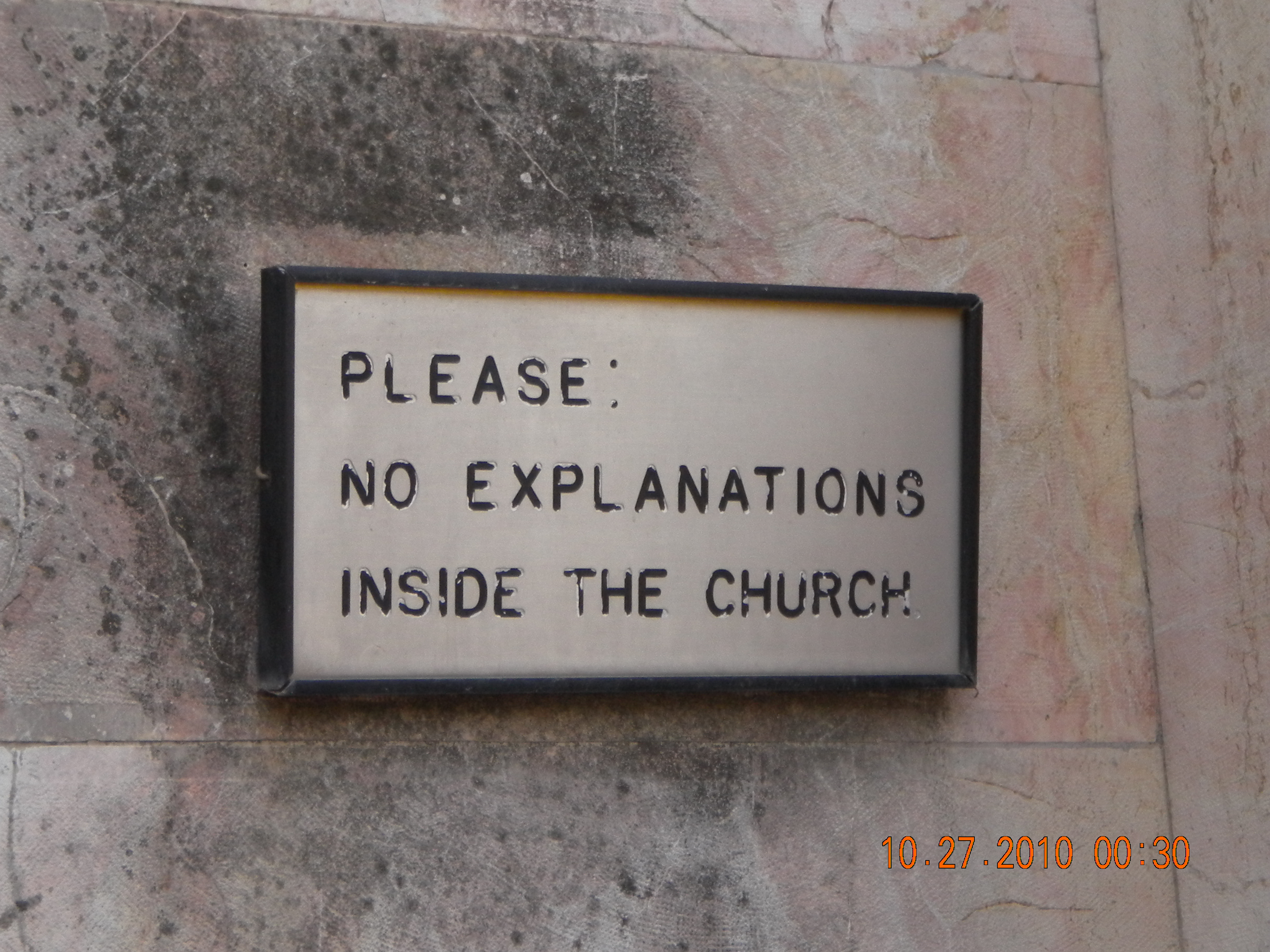
This is an interesting photo.  It’s in a church in Israel and is intended to keep tour guides and others from talking in the sanctuary, thereby preserving its purpose as a place of prayer.  But . . .

no explanations in church

The APPA Cross

Our high school students go on an annual mission trip called APPA.  The program began with trips to support missions in the Appalachians.  We no longer go there, but the name has stuck.  APPA 2015 took place in Dalhart, Texas.  This is a reflection inspired by this trip and those before it.

appa 2015 cross

I’m not sure how or when the tradition of making a cross started, but I think it’s relatively recent.  On my first APPA, we all signed a board that went into the project, but it was hidden away inside the construction, like a beam signing for a church building.  Today each work team makes a cross, signed by each member of the team, usually containing our theme scripture for the week.

It seems natural for a church group to leave behind a cross as a marker of its work, but in a short time these crosses have become the symbol for the trip and the work.  When I build a wheelchair ramp, I like to do a “victory run” where the team lines up on each side of the ramp to cheer while the homeowner comes down the ramp.  It’s a ritual to mark handing over the ramp to the homeowner.  The crosses have created a different ritual.  The team presents the cross to the homeowner as a way to present the completed project.  You can see two cross presentations in this video.  Note also the prominence of the crosses with the work teams.

cross collage

Homeowners are as proud of the crosses as they are of the entire project.  They like to have them displayed in prominent places.  Floyd, a 2014 homeowner in very poor health, told his family he wants to be buried with his.

wpid-img_20140620_163901_122.jpg

According to Thomas Aquinas, Jesus on the cross opens his arms wide, to receive all humanity, while at the same time pointing upward to our heavenly Father.  The APPA cross shows how homeowners and work teams receive each other, transforming each other’s lives to the glory of God.  One day I hope to drive through a small town and see a project with a small cross next to it, the mark of gifts given and received.

Random Thursday for July 9, 2015

random st

If you can’t get a Walmart moment at Walmart, go to a hospital.

Bill Cosby used to be one of the most respected men in America.  So was O.J. Simpson.  People are like icebergs, there’s so much going on below the surface.

“Sin is the form our character takes as a result of our fear that we will be ‘nobody’ if we lose control of our lives” – Stanley Hauerwas

Every July 4th I hear Bruce Springsteen’s “Born in the USA”.  Three floats in the Independence Day parade used it.  So did the fireworks display that night.  They haven’t paid attention to the lyrics.  It’s not a patriotic song.

Paula Jones is back, reminding us of old accusations against the Clintons.  She has profited well from being a whistleblower, getting free cars and cosmetic surgery in exchange for her story.  Is this what a quest for justice should look like?

(Image is “random street” by Andrew Barclay on Flickr.  CC BY-NC 2.0.  I’ve never been there.)

The APPA Note

Our high school students go on an annual mission trip called APPA.  The program began with trips to support missions in the Appalachians.  We no longer go there, but the name has stuck.  APPA 2015 took place in Dalhart, Texas.  This is a reflection inspired by this trip and those before it.

Notes by Brady

This was the 35th APPA.  The event has picked up plenty of traditions; my favorite is the APPA note.  It’s a personal note you write to someone on the trip who has touched your life.  Since APPA comes at the end of the school year, many APPA notes become statements about the whole year.    There’s a minimum expectation that you’ll write APPA notes to people in your work group.  Once I start, I have a hard time stopping.  After my work group, I write notes to 11th graders (the grade level I work with), 10th graders (who I teach in Sunday School), to the other adult volunteers (because we’re our own support group), and to graduating seniors (to wish them well).  Why?  Because I have learned more about myself through APPA notes than nearly anything else.  Writing that note means taking the time to say what we really mean to each other.  There have been no more significant milestones in my spiritual journey than my APPA notes.

The notes told me I have a good way with people.  The adults said I had a good way with the students; the students said I was fun and good to work with.  I’m an introvert – none of this should be true.  When my children graduated, the notes told me to keep working with youth.  During the APPAs when I helped students plan the evening worship, the notes told me it wouldn’t have happened without me.  (I still think that’s giving me too much credit.)  It is amazing how much gratitude fits in a simple note.  The simpler the note, the greater the gratitude.  The note that still blows me away, two years later, contains only four words:  What gifts you have.

When I reached a point in my career where I had to either leave or become one of the working dead, those notes showed me the way.  I am an introvert with people skills.  Youth like having me around.  I help people organize themselves.  I have gifts.

Enough about me.  Here’s the takeaway:

  • You never know how you’ve touched someone’s life. But you have.
  • You touch lives in more ways than you know. You have gifts.
  • Your gifts may be invisible to you, but not to those around you. Pay attention.
  • If certain people are doing good in your life – tell them. They probably don’t know.
(Image is “Notes” by Brady on Flickr.  CC BY 2.0. )

Random Thursday for July 2, 2015

rowntree's random sweets

What stand would the Texas Attorney General take if a clerk won’t issue concealed carry permits on religious grounds?

Rants on same sex marriage immediately turn to polygamy.  Ironically enough, polygamy is in the Bible.

Just discovered Brain Pickings, a great dose of randomness.  Check it out.  If you like it, subscribe and support.

If you Google the lyrics to Sanctuary, you won’t find the second verse.  I don’t know where it came from.  How do we know it?

(Image is “rowntree’s randoms sweets” by fsse8info on Flickr.  CC BY-SA 2.0.  I’ve never eaten one.)

Another Church-State Thought

If you read the Constitution, you don’t find the phrase “separation of church and state”, even though we say there’s a provision for separation of church and state in it.  Based on a comment from a previous blog entry, I thought I’d look at the issue.  So I turned to http://www.constitution.org, the official web site of The Constitution Society.  Here’s what I learned.

The phrase “separation of church and state” comes from a letter Thomas Jefferson wrote to the Danbury Baptist Association in 1802.  They wrote Jefferson wondering why he had not declared national days of fasting and thanksgiving.  (Would anyone really fast if we had a day of fasting?)  Here’s Jefferson’s reply.  I put the key phrase in bold.  You can find this at http://www.constitution.org/tj/sep_church_state.htm.

To messers Nehemiah Dodge, Ephraim Robbins, & Stephen S. Nelson, a committee of the Danbury Baptist association in the state of Connecticut.

Gentlemen

The affectionate sentiments of esteem & approbation which you are so good as to express towards me, on behalf of the Danbury Baptist association, give me the highest satisfaction. my duties dictate a faithful & zealous pursuit of the interests of my constituents, and in proportion as they are persuaded of my fidelity to those duties, the discharge of them becomes more & more pleasing.

Believing with you that religion is a matter which lies solely between man & his god, that he owes account to none other for his faith or his worship, that the legitimate powers of government reach actions only, and not opinions, I contemplate with sovereign reverence that act of the whole American people which declared that their legislature should make no law respecting an establishment of religion, or prohibiting the free exercise thereof, thus building a wall of separation between church and state. [Congress thus inhibited from acts respecting religion, and the Executive authorised only to execute their acts, I have refrained from presenting even occasional performances of devotion presented indeed legally where an Executive is the legal head of a national church, but subject here, as religious exercises only to the voluntary regulations and discipline of each respective sect.] Adhering to this expression of the supreme will of the nation in behalf of the rights of conscience, I shall see with sincere satisfaction the progress of those sentiments which tend to restore to man all his natural rights, convinced he has no natural right in opposition to his social duties.

I reciprocate your kind prayers for the protection and blessing of the common Father and creator of man, and tender you for yourselves and your religious association, assurances of my high respect & esteem.

(signed)
Th Jefferson
Jan.1.1802.

The phrases “should make no law respecting an establishment of religion” and “prohibit[ing] the free exercise thereof” come from the First Amendment, which is given here:

Congress shall make no law respecting an establishment of religion, or prohibiting the free exercise thereof; or abridging the freedom of speech, or of the press; or the right of the people peaceably to assemble, and to petition the Government for a redress of grievances.

Jefferson is saying that since Congress “shall make no law respecting an establishment of religion, or prohibiting the free exercise thereof”, there exists a wall of separation between church and state.  It appears that Jefferson is saying the First Amendment builds a wall between church and state.  While it is true that Constitution does not contain the phrase “separation of church and state,” as far as Jefferson was concerned, it contains the concept.


Final Thoughts on LPYC Choir Tour – Day Nine – Reality and Connections

This is the final blog entry inspired by the 2014 tour of the Living Proof Youth Choir (LPYC) of Christ UMC in Plano, Texas.  It isn’t meant to be a summary of the tour, but a set of reflections prompted by events on the trip.

I wanted to blog and figured if choir tour didn’t give me enough material, then nothing could, so I challenged myself to write an entry per day.  OK, I fudged it a little by combining some days, but I had good reasons.  Here we come to the last entry for choir tour – but not for the blog!

Enough time has passed that any emotional high I got from the trip has been beaten back into submission by everyday life, which makes it a good time to add some final remarks.

The one-word sermon for this trip would have to be connections.  You can tell from the previous entries that the music provided a common ground for the choir to make connections with people who didn’t live in their everyday world.  If New Kingdom Church can feel like family, if you can share stories with the people at Breakthrough Ministries, if you can hold the shaking hand of an elderly woman and tell her about your school, you’ve made connections.

The final stop on tour is our own church.  The choir sings for the three worship services we have in the sanctuary.  The congregation is parents, siblings, and friends, but there’s still the challenge of connecting.

We did our final devotional while on the road back to Plano.  Our group’s discussion moved from the devotional to that very challenge.  How can we communicate to the people at home what kind of week we had?  I could tell a difference in their singing as the week passed.  Those songs had people and stories attached to them and singing was a way to reconnect with those people and those stories.  It’s the step beyond owning the message:  the message owns you.

This was not just the last stop on the tour.  Trey, the director, was leaving our church to move back to Alabama.  For the past three years Trey has been a director, example, mentor, friend, coach, resource, you-name-it for the youth in this choir.  Trey would do anything for these youth and they would do anything for him.  (He also writes a very good blog.)

So they sang the three services.  The congregation loved the music, as we knew they would.  The video told some of the stories from the tour.  For the third service, the chaperones made the congregation stand and clap for Praise His Holy Name, just to try to capture that feeling.

Then it came time for that last song at the last service and the last time Trey would lead the choir.  This was about more than the last week, it was about the last three years.  How do you get through a song that means goodbye?  You do it by connecting.  As Trey stepped up to direct, the singers on the front row joined hands, followed by the second row, then the next and the next.  Our connections make us stronger.  As we made those connections outside ourselves, it became easier to make those connections between ourselves.  It’s hard to wipe your eyes when you’re holding hands, but the choir managed to cry, sing, and hold hands all at once.

Trey thanked the congregation, stepped back to the choir and fell into the largest group hug I’ve ever seen.

group hug edit

I don’t think the choir could have shown the congregation everything they experienced that week, but that moment said a lot.

I began this series with a challenge to myself, so let me end it with a challenge to you.  There are really only two things God wants you to do:  to love and serve God and to love and serve your neighbor.  It’s a short and difficult list, but when you’re doing it, you realize that this is Reality.  I believe for a week this past July, the Living Proof Youth Choir did it as well as fallible humans can.  The challenge is to bring Reality into your everyday lives.  You start by connecting.